
On this page
Key takeaways
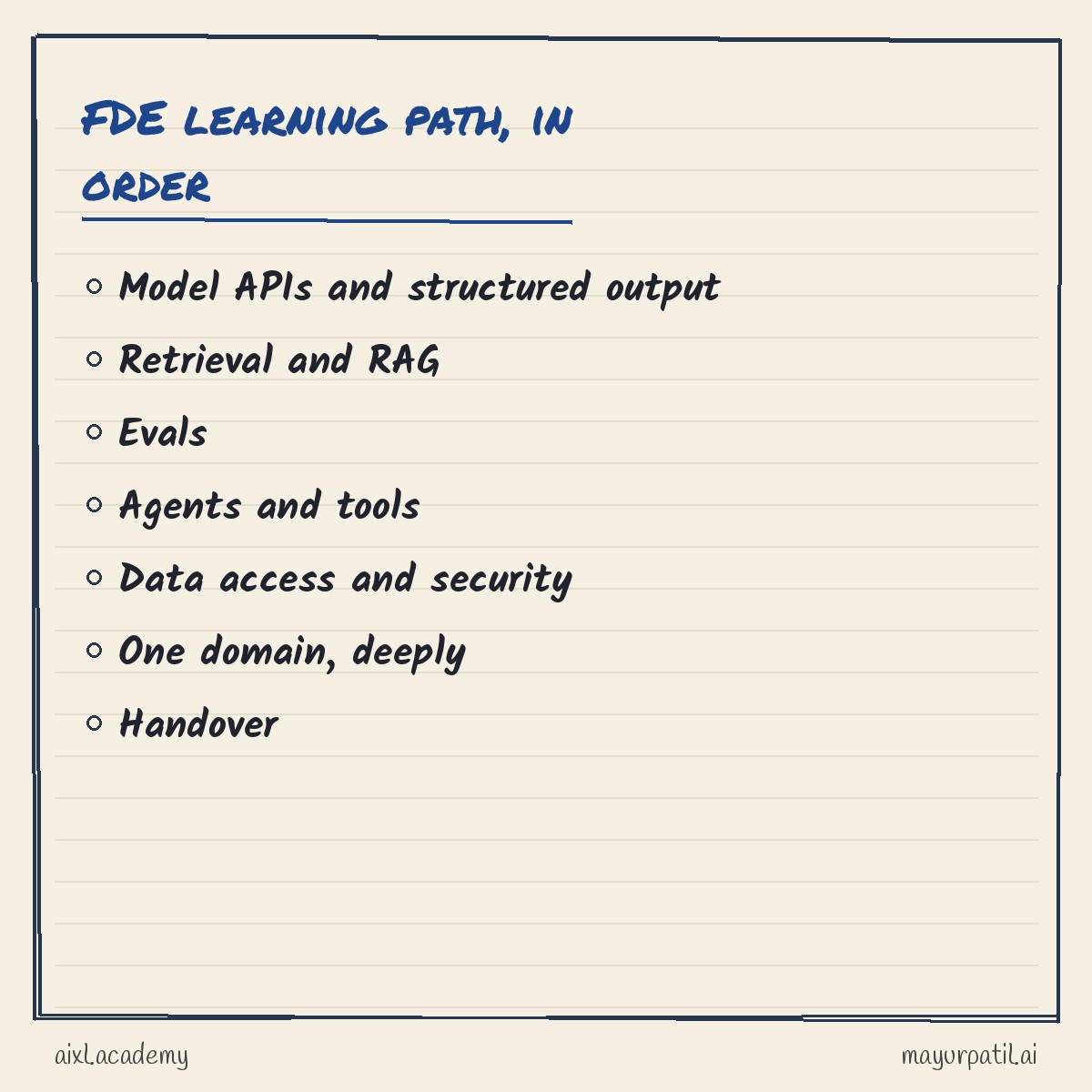
- Learn in order: model APIs and structured output, retrieval, evals, agents and tools, data access, one domain, handover.
- Each stage ends with something you build, because interviews ask about things you shipped.
- Hiring has moved toward building: demand for basic prompting skills fell while demand for hands-on AI engineering rose.
- Move on when you have built the thing at the end of the current stage, not after a fixed number of weeks.
People ask us the same question every week: I want to become a forward deployed engineer (FDE), what should I learn first?
This is the order we recommend. Each stage ends with something you build, because FDE interviews ask about things you shipped, not courses you finished.
Why this order: hiring has shifted toward building. Workday's Global Workforce Report (5 October 2026) found demand for basic AI skills such as simple prompting fell 25% after January 2026, while demand for hands-on skills like building AI tools and AI engineering rose 51% between September 2025 and July 2026. FDE postings go further. A senior FDE posting from EY (1 November 2026) lists four disciplines: software engineering, AI and platform fluency, sector knowledge and customer leadership. The path below covers all four.
Stage 0: the base you need
Comfortable Python, HTTP APIs, JSON, SQL and Git. If any of these is shaky, fix it first. Everything later depends on them.
Stage 1: model APIs and structured output
Learn to call a model API directly, ask for a fixed output structure, and validate every response in code before you use it.
Build: a small script that reads support emails and returns a category and a priority as validated JSON.
Stage 2: retrieval and RAG
Learn embeddings, chunking, search and how to put retrieved text in front of the model. Learn to check retrieval separately from the answer.
Build: a question answering tool over one set of real documents, with a list of 30 real questions and a check for whether the right passage is retrieved.
Stage 3: evals
Learn to write a test set from real tasks, score outputs, and run the tests every time you change a prompt or a model.
Build: an eval script for your Stage 2 tool that prints a score you can compare week to week.
Stage 4: agents and tools
Learn the difference between workflows and agents, the common patterns (prompt chaining, routing, parallelization, orchestrator-workers, evaluator-optimizer) and how to write tool definitions a model can use. Anthropic's "Building effective agents" is a good reference for the vocabulary.
Build: a workflow that uses two tools, with a human approval step before any action that changes data.
Stage 5: data access and security
Learn how enterprises grant access: service accounts, least privilege, what a security reviewer will ask, and how to write a data access request.
Build: write the access request for your Stage 4 project as if a real security team will read it.
Stage 6: one domain, deeply
Pick one industry (finance, supply chain, healthcare, retail, operations) and learn its vocabulary, its core workflows and its rules. This is the sector knowledge that job posts ask for and most engineers skip.
Build: a one page description of one real workflow in that domain, with where AI would help and where it should not be used.
Stage 7: handover
Learn to leave a system someone else can run: a runbook, the eval set and how to extend it, an owner and an escalation path.
Build: the handover pack for your project, then ask a friend to run it without you.
How long it takes
It depends on where you start and how much time you have. Do not trust any fixed number of weeks. Move to the next stage when you have built the thing at the end of the current one.
Practise with feedback
If you want to work through this path on a real build, with your work assessed rather than your attendance, the AIXL Academy Forward-Deployed AI Engineering cohort follows the same order.
Sources
- Workday, Global Workforce Report press release (5 October 2026): https://investor.workday.com/news-and-events/press-releases/news-details/2026/Workday-Global-Workforce-Report-AI-Is-Rewriting-Jobs-More-Than-Its-Cutting-Them/default.aspx
- EY, Forward Deployed Engineer, Senior job posting (1 November 2026): https://careers.ey.com/ey/job/FDE/1453196233/
- Anthropic, "Building effective agents" (19 December 2024): https://www.anthropic.com/engineering/building-effective-agents
Written by
AIXL Academy
AIXL Academy trains engineers to build and ship AI systems for real customers. Subscribe by RSS or follow the AIXL Academy page on LinkedIn for new question banks.
Keep reading
Interview questions
LLM evals cheat sheet: what to check, how, and when
A one page guide to evaluating LLM and agent systems: code checks, rubrics, model judges, eval sets and when to run them.
Interview questions
AI engineering system design interview questions, with what good answers cover
Common system design questions for AI engineer and forward deployed engineer interviews, and what a strong answer covers for each.