
On this page
Key takeaways
- A forward deployed engineer interview loop tests how you handle a messy customer problem, not only coding.
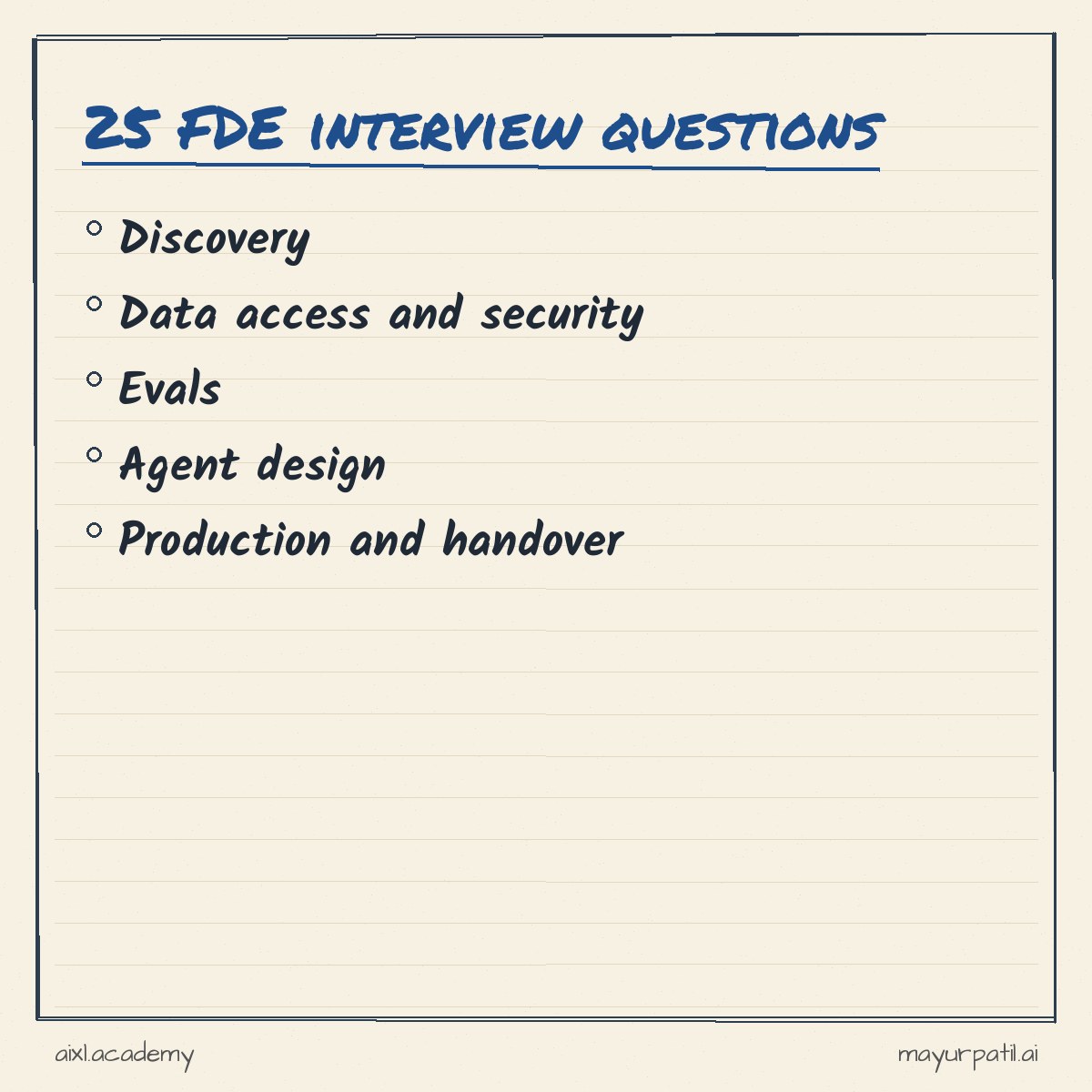
- Expect separate parts for discovery, data access and security, evals, agent design and handover.
- Practise each part by producing a written artefact from a real build, such as a data access request or a handover pack.
- Use the question bank for prompts, and this process guide for how to structure your practice.
Candidates preparing for a forward deployed engineer interview often collect long question lists and memorise answers. That approach breaks down quickly, because the loop tests how you work through an unclear problem, not whether you recognise a question. This guide describes the parts a typical loop covers and how to practise each one.
Loops differ between companies, so treat this as a map of what to expect, not a fixed agenda.
Part 1: discovery
You are given a vague business request and asked what you would ask first. The interviewer watches whether you find the real problem, name the owner, and decide whether AI is the right tool. A good answer asks about the current process, the users, the failure cost and the definition of success before proposing a design.
Part 2: data access and security
Expect questions about how you would reach the data, who grants access, and what a security reviewer would challenge. Strong answers name least privilege, service accounts and what gets logged. They do not assume the data can be copied freely.
Part 3: a build or a walkthrough
Some loops ask you to talk through a system you built, or to sketch one. The interviewer tests the decisions: how retrieval was checked, what the model returns, where a human approves an action, and what breaks first. Bring one project you can explain in detail, rather than several you can describe only in outline.
Part 4: evals
You will be asked how you know the system works. Strong answers describe a test set from real tasks, a scoring method, and a rule for running the tests after every prompt or model change. Weak answers stop at a demo that looked right once.
Part 5: agent design and handover
The final parts test whether you can leave a system someone else can run. Expect questions on tool design, where a human checks an action, and what a runbook and owner look like after launch.
How to practise
Practise with artefacts, not only spoken answers. Write a one-page discovery note for a real workflow. Write a data access request for a project. Write an eval plan with a scoring rule. Write a handover pack and ask a friend to run it. Each artefact gives you something concrete to describe in the room.
For the question bank that pairs with this process, read FDE interview questions. For system design prompts, see AI engineering system design interview questions.
Forward Deployed AI Engineering is a 60-hour live cohort for working engineers. The fee is USD 1,799 per participant. Enquire about the next intake.
Related reading: FDE interview questions, AI engineering system design interview questions, RAG evals interview questions.
Frequently asked questions
Try it first: turn on practice mode to hide the answers, think through each question, then reveal.
Is the FDE interview mostly coding?
What a good answer covers
Not usually. Coding is one part, but the loop also tests discovery, data access, evals and handover on a messy customer problem.
How should I prepare for FDE interviews?
What a good answer covers
Build one small system and produce written artefacts from it, such as a discovery note, a data access request and an eval plan. Then practise explaining each decision out loud.
Should I memorise a list of FDE questions?
What a good answer covers
No. Use question lists to find the topics, then practise structured answers that name the owner, the data, the test and the exit plan.
Sources
- None: AIXL Academy curriculum practice, no external facts or figures.
Written by
AIXL Academy
AIXL Academy trains engineers to build and ship AI systems for real customers. Subscribe by RSS or follow the AIXL Academy page on LinkedIn for new question banks.
Train for this role
Interview answers improve when you have built the system. The cohort builds one with you and assesses the build.
Next cohorts: weekend from 21 November 2026, weekday from 18 November 2026.
forward deployed AI engineer courseKeep reading
Learning guide
AI for managers: what to learn if your team is deploying AI
What managers need to learn about AI when their team is deploying it: the questions to ask, the evals to request, and how a builder course differs.
Career guide
Switch career to AI: a plan that can lead to FDE work
A practical plan to switch career to AI, with an honest prerequisite check and the build steps that can lead toward forward deployed engineering work.