On this page
Key takeaways
- Check your software basics first, because forward deployed engineering is not a from-scratch coding course.
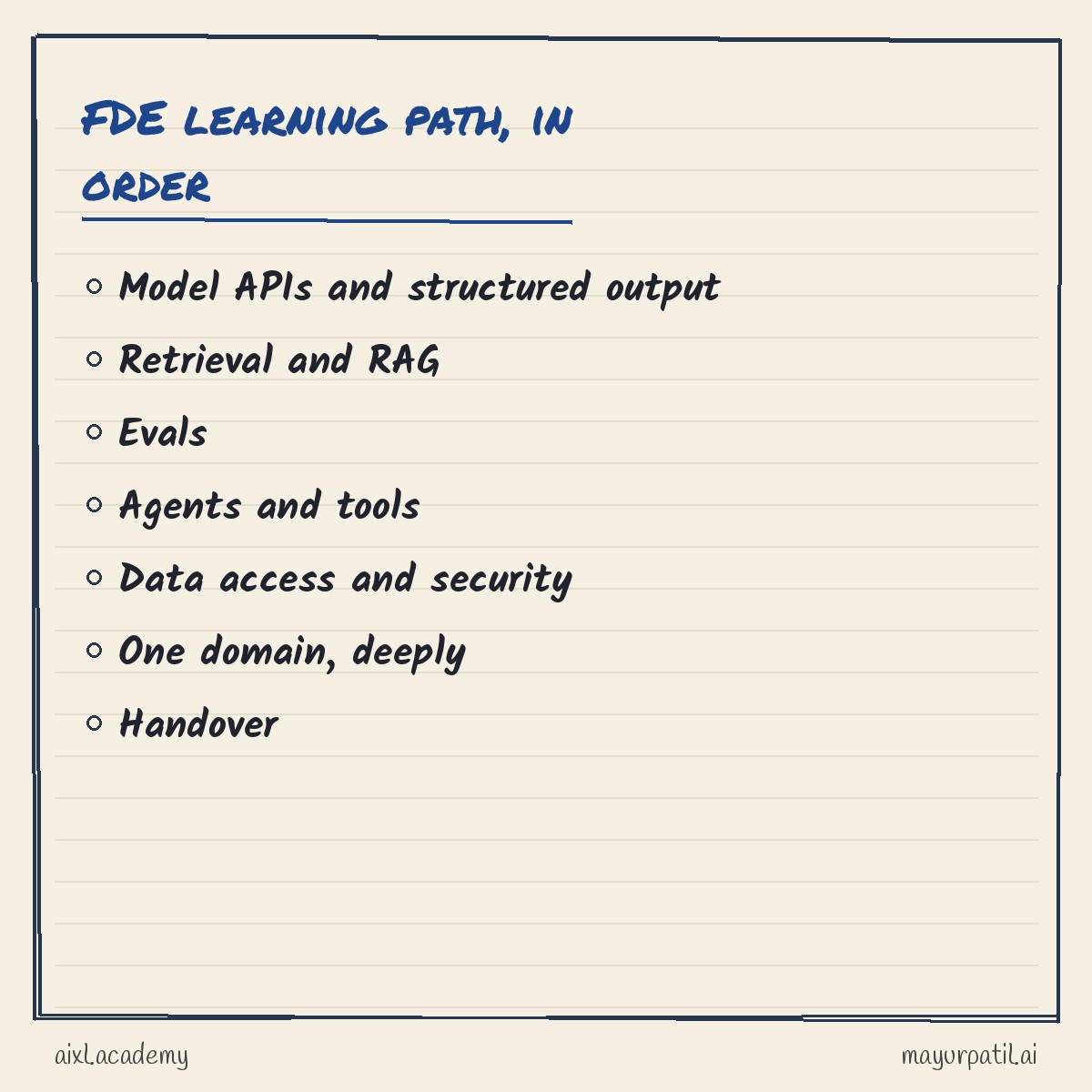
- Build in order: model APIs, retrieval, evals, agents, one domain, then a portfolio that shows delivery.
- Each step ends with a small build you can show, not a certificate.
- There is no fixed timeline. Move on when the current build works.
Switching career to AI is a real option, but the route depends on where you start. This guide sets out a plan you can test against your own background. It also says plainly where forward deployed engineering (FDE) fits, and where it does not.
Start with an honest check
FDE is not a from-scratch coding course. The role expects working software skills: Python, HTTP APIs, JSON, SQL and Git. If you have not used these before, your first months should go to them. Skipping them makes every later AI topic harder.
If you already write software for a living, the switch is shorter. You are adding model APIs, retrieval, evals and agents to skills you already have.
Step 1: call a model and check the output
Start by calling a model API from code. Ask for a fixed output structure, validate it, and log what fails. This is the first build most engineers make, and it shows quickly whether you enjoy the work.
Step 2: build retrieval and evals
Pick a set of real documents and build a small question answering tool over them. Write a list of real questions, check whether the right passage is retrieved, and score the answers each time you change the prompt. Evals are the habit that separates builders from people who only try tools.
Step 3: add agents and tools
Learn when a fixed workflow is enough and when an agent is needed. Write tool definitions a model can use, and put a human check in front of any action that changes data or sends a message.
Step 4: pick one domain
FDE work is customer work. Choose one sector, such as finance, operations or healthcare, and learn its vocabulary, workflows and rules. Write a one-page description of one real workflow, including where AI should not be used.
Step 5: make a portfolio that shows delivery
Employers read projects. A project with a problem statement, notes on data access, an eval score, a failure log and a handover pack says more than a certificate. Keep each project small enough to finish.
Decide if the switch fits you
Ask yourself three questions. Do you enjoy debugging a system that does not behave? Can you give steady hours each week for months, not just one weekend? Do you want work that sits between engineering and a customer's problem? If the answer to all three is yes, the plan above is worth starting.
Be realistic about timing
No fixed timeline is promised here. Each stage finishes when you have built the thing at its end, not after a set number of weeks. Some people move faster because they already write production code. Others need longer on the software basics.
Related reading: A learning path for forward deployed engineers, Software engineer to forward deployed engineer, How to become an AI engineer as a working professional.
Forward Deployed AI Engineering is a 60-hour live cohort for working engineers. The fee is USD 1,799 per participant. Enquire about the next intake.
Frequently asked questions
Try it first: turn on practice mode to hide the answers, think through each question, then reveal.
Can I switch to AI without a computer science degree?
What a good answer covers
Yes, if you can build and test working software. What counts most is evidence that you can build, test and explain a system.
Is forward deployed engineering a good first AI job?
What a good answer covers
No. FDE is not an entry-level role, so most people build their software and AI skills first, then move toward FDE work.
How long does a switch to AI take?
What a good answer covers
It depends on your starting skills and the hours you can give. Move to the next step when you have built the thing at the end of the current one.
Sources
- None: AIXL Academy curriculum practice, no external facts or figures.
Written by
AIXL Academy
AIXL Academy trains engineers to build and ship AI systems for real customers. Subscribe by RSS or follow the AIXL Academy page on LinkedIn for new question banks.
Train for this role
The cohort teaches these skills by building and shipping a system, assessed on the work.
Next cohorts: weekend from 21 November 2026, weekday from 18 November 2026.
forward deployed AI engineering courseKeep reading
Learning guide
AI for managers: what to learn if your team is deploying AI
What managers need to learn about AI when their team is deploying it: the questions to ask, the evals to request, and how a builder course differs.
Comparison
GenAI training vs FDE training: when a GenAI course is enough
Compare GenAI training with forward deployed engineer training. Learn when a GenAI course is enough, when an FDE track fits, and how to decide.