
On this page
Key takeaways
- An AI engineer roadmap has four layers: software foundations, model use, system behaviour, and measurement and operation.
- Specialisations branch after those layers. Forward deployed engineering is one branch, focused on the customer workflow.
- Build one small project per layer and move on when you have something you can show.
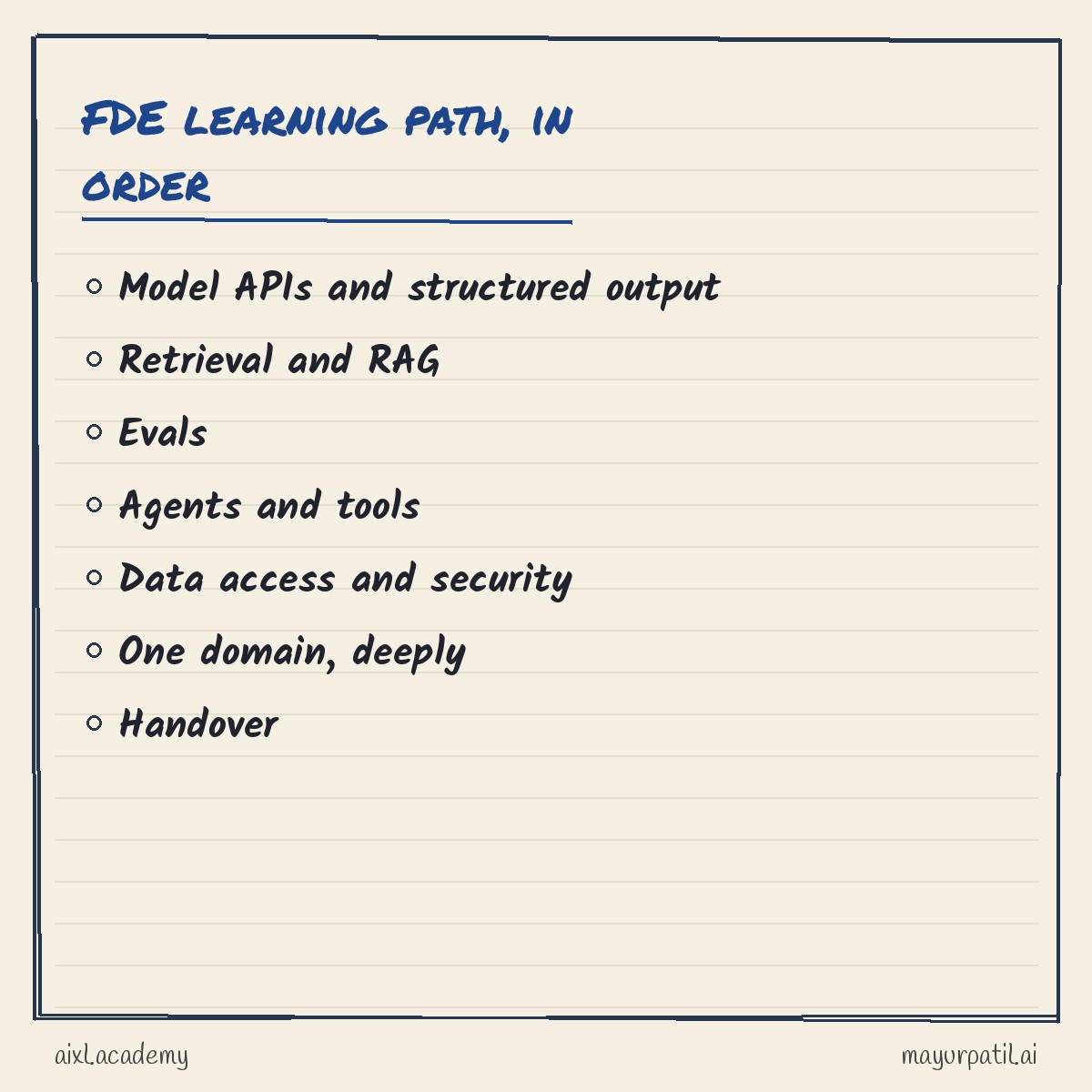
- For the FDE skill order itself, follow the forward deployed engineer learning path.
People who search for an AI engineer roadmap usually want a map of the whole field, not one specialisation. This post gives that map at a high level, then shows where forward deployed engineering (FDE) fits. For the skill order of the FDE role itself, read the learning path linked below.
The four layers of the work
A useful way to see the role is as four layers.
The first is software foundations: Python, HTTP APIs, JSON, SQL, Git and testing. Every later layer depends on them.
The second is model use: calling a model API, asking for structured output, and validating each response in code before it goes further.
The third is system behaviour: retrieval, tool use, workflows, and agents that act across several steps. This layer is harder to test, because the parts interact and a single answer can look right while the process behind it is wrong.
The fourth is measurement and operation: evals, monitoring, cost and latency, and a runbook that another person can follow.
Where the specialisations branch
Once those layers are in place, the work branches. Some engineers go deep into model training or inference. Some build AI platforms for other teams. Some focus on applied product work. FDE is one branch. It puts the emphasis on the customer workflow, data access and handover, rather than on model research or platform ownership.
That is why an AI engineer roadmap and an FDE path look similar at the start and differ later. The roadmap names the whole field. The FDE path names the skills for one role.
How to use a roadmap
Pick the layer you have not yet built. Build one small project for it, then write down what broke. Move on when you have a working piece you can show, not because a course has ended.
Keep the map short. A roadmap that lists forty tools is a shopping list, not a plan. Choose the tools your target role names in its job posts, and leave the rest until a project needs them.
When FDE is the right branch
Consider FDE if you like working on a customer problem, you are comfortable with messy data, and you want to see your code used in a live workflow. If you prefer deep model work or shared infrastructure, another branch may fit better.
Forward Deployed AI Engineering is a 60-hour live cohort for working engineers. The fee is USD 1,799 per participant. Enquire about the next intake.
Related reading: Forward deployed engineer learning path, AI engineering system design interview questions and Agentic AI interview questions.
Frequently asked questions
Try it first: turn on practice mode to hide the answers, think through each question, then reveal.
Is there one official AI engineer roadmap?
What a good answer covers
No. The field is wide, and job posts name different skills for different roles. Use a roadmap to see the layers, then choose the branch that matches your goal.
How does an AI engineer roadmap differ from the FDE learning path?
What a good answer covers
The roadmap maps the whole field across four layers. The FDE learning path gives the skill order for one role, with a build at the end of each stage.
Where should I start if I already write software?
What a good answer covers
Start with model use. Build a small project that calls a model API and validates its output, then add retrieval and evals before you move into agents.
Sources
- None: AIXL Academy curriculum practice, no external facts or figures.
Written by
AIXL Academy
AIXL Academy trains engineers to build and ship AI systems for real customers. Subscribe by RSS or follow the AIXL Academy page on LinkedIn for new question banks.
Train for this role
This path is the order the cohort follows. Each stage ends with a build you can show.
Next cohorts: weekend from 21 November 2026, weekday from 18 November 2026.
live FDE training cohortKeep reading
Learning guide
AI for managers: what to learn if your team is deploying AI
What managers need to learn about AI when their team is deploying it: the questions to ask, the evals to request, and how a builder course differs.
Career guide
Switch career to AI: a plan that can lead to FDE work
A practical plan to switch career to AI, with an honest prerequisite check and the build steps that can lead toward forward deployed engineering work.