
On this page
Key takeaways
- A forward deployed engineer owns a customer outcome, not a backlog.
- Your proof is a working system with an evaluation and a handover, not a certificate.
- Build one system end to end before you apply anywhere.
- Structured training helps when it ends in assessed work.
Most people who ask how to become a forward deployed engineer already write code. The gap is not programming. It is owning a problem inside a customer's environment, from the first conversation to a system that someone else can run.
What the role actually is
A forward deployed engineer (FDE) works close to the customer. They find the real workflow, decide what can be automated safely, build the integration, and leave the customer able to run it. The job ends when the system works in the customer's hands, not when the code is merged.
That means the role asks for three things at once: engineering depth, judgement about what to build, and the discipline to hand over.
Who it suits
The route is clearest for engineers who already work on production systems: backend, data, platform, or integration engineers. It also suits solution engineers who want more build work. If you have never shipped a service that people depend on, start there first. Good FDEs are not entry-level roles.
A practical route in four steps
1. Build one system end to end. Pick a workflow with real inputs, a permission boundary and a measurable outcome. Connect a model to it, add retrieval over the documents it needs, and make it fail safely.
2. Put an evaluation on it. Write down what a correct answer looks like before you change the prompt. Keep a small labelled set and check every change against it. Employers look for this more than for the model you chose.
3. Write the handover. Document the runbook, the escalation path, the owner and the known limits. A short handover note is a stronger signal than a long architecture diagram.
4. Practise the interview loop. FDE interviews test how you scope a vague problem, how you choose between two designs, and how you explain a trade-off to a non-engineer. Rehearse those out loud.
What to avoid
Do not chase a list of tools. Do not present a demo as a deployment. Do not apply for the title before you can show one system that runs. The role rewards the person who finishes the last step, which is the handover.
Where to go next
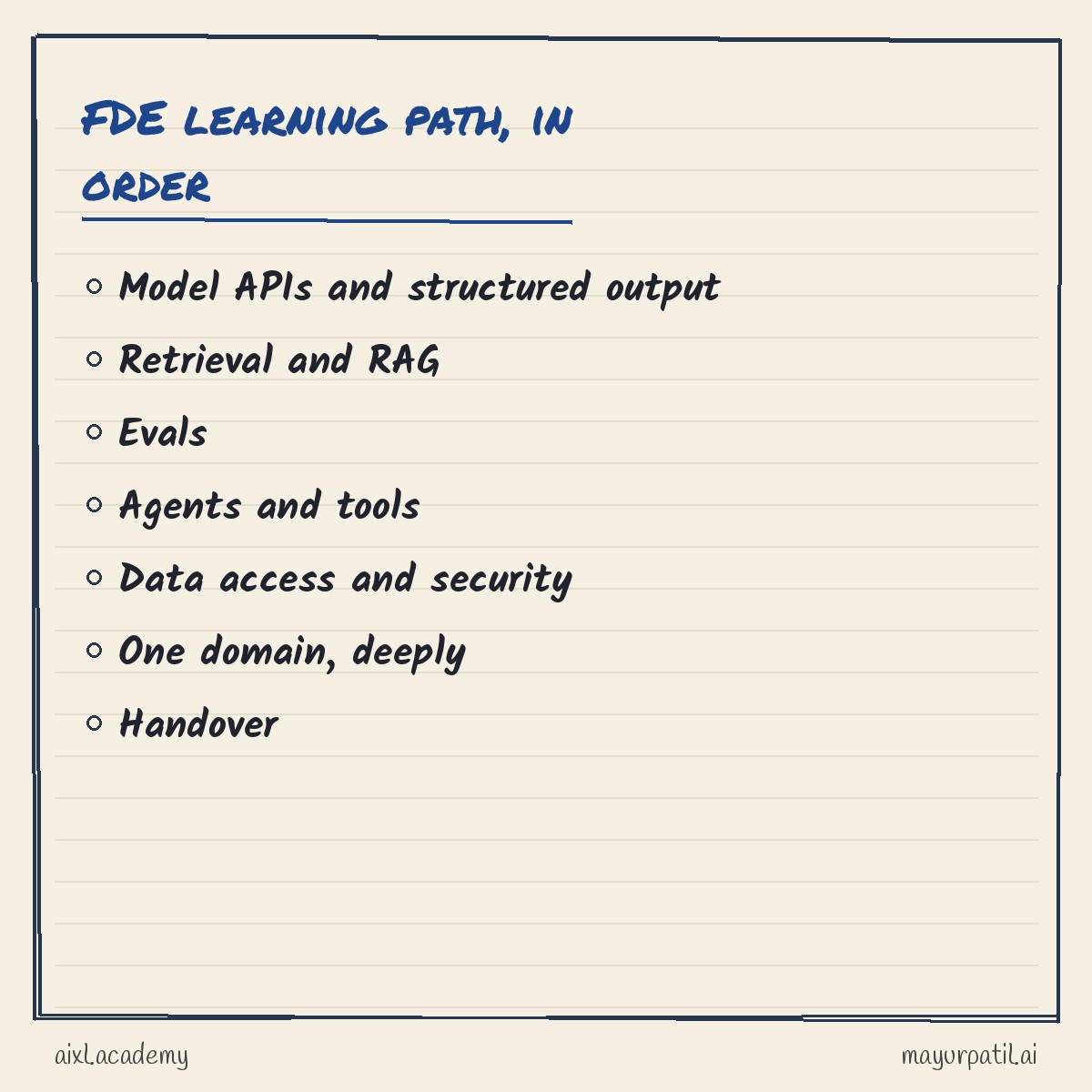
If you want the skill order for the build itself, read the learning path. If you are preparing for the interview loop, read the FDE interview questions. Engineers who are still choosing between roles can compare the agentic AI and FDE route.
Forward Deployed AI Engineering is a 60-hour live cohort for working engineers. The fee is USD 1,799 per participant. Enquire about the next intake.
Related reading: FDE learning path and FDE interview questions.
Frequently asked questions
Try it first: turn on practice mode to hide the answers, think through each question, then reveal.
Do I need a computer science degree to become a forward deployed engineer?
What a good answer covers
No. Employers look for a working system and clear reasoning about it. A degree helps some people, but it is not the proof the role asks for.
How long does the transition take?
What a good answer covers
It depends on your current work and how much time you can give it. Plan around finishing one end-to-end system and its handover, then apply.
Is a forward deployed engineer the same as an AI engineer?
What a good answer covers
No. An AI engineer may focus on models and pipelines. A forward deployed engineer owns the customer outcome from discovery to handover.
Written by
AIXL Academy
AIXL Academy trains engineers to build and ship AI systems for real customers. Subscribe by RSS or follow the AIXL Academy page on LinkedIn for new question banks.
Train for this role
The cohort teaches these skills by building and shipping a system, assessed on the work.
Next cohorts: weekend from 21 November 2026, weekday from 18 November 2026.
forward deployed AI engineering courseKeep reading
Learning guide
AI for managers: what to learn if your team is deploying AI
What managers need to learn about AI when their team is deploying it: the questions to ask, the evals to request, and how a builder course differs.
Career guide
Switch career to AI: a plan that can lead to FDE work
A practical plan to switch career to AI, with an honest prerequisite check and the build steps that can lead toward forward deployed engineering work.