
On this page
A chatbot over a PDF no longer makes AI engineer portfolio projects stand out. Reviewers have seen hundreds. What they look for now is evidence that you can build something that works on real inputs, measure it and explain your decisions.
This post covers what makes a project worth reading, then five project ideas with a checklist for each.
What makes a project stand out
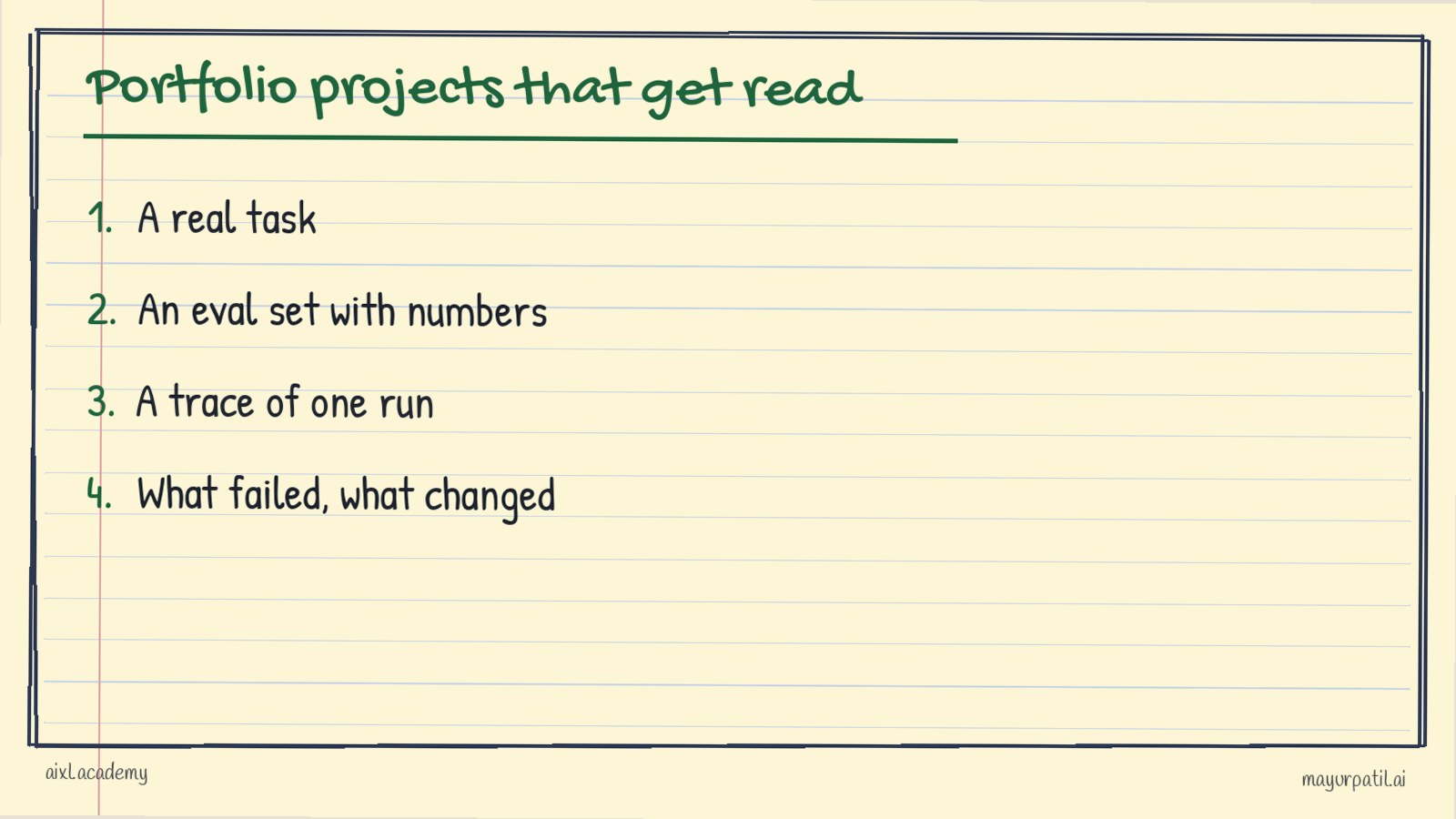
In our experience reviewing learner builds, four things matter most.
A real task. Something a person does today, described in their words. "Sort support emails by urgency and draft a first reply" is better than "an AI assistant".
An eval set with numbers. Twenty or more real cases, a description of what good looks like, and the score before and after your changes. This is the single biggest signal.
A trace of one full run. Show the steps: what was retrieved, which tools were called, what came back. A reviewer can see how you think.
A short write up of what failed. What did not work, what you changed and why. Honest failure notes are more convincing than a perfect demo.
Five project ideas
1. Support email triage
Classify incoming emails by category and urgency, and draft a reply for review.
- Structured output validated against a schema.
- An eval set with tricky cases: two issues in one email, angry tone, wrong language.
- A rule for when to hand to a person.
2. Policy question answering with permissions
Answer questions from a set of documents where different users may see different documents.
- Chunking by structure and metadata on each chunk.
- Retrieval filtered by user permissions, tested with a low access user.
- A retrieval eval that runs without calling the model.
3. An agent that updates records
Read a request and update a record in a small database, with approval for risky changes.
- Clear tool descriptions and contracts.
- Approval step for actions with side effects.
- An audit record for every run.
4. Search over a catalogue with codes
Answer questions over product manuals where users search by part number.
- Vector search compared with hybrid search, with numbers.
- Re ranking and a small number of chunks sent to the model.
- A note on which queries improved and which did not.
5. Cost and latency tuning
Take one of the projects above and make it faster and cheaper without losing quality.
- A latency budget per step, measured at the 95th percentile.
- Prompt caching with a stable prefix, and the hit rate before and after.
- Routing simple requests to a smaller model, with evals on both paths.
How to present it
- A README that starts with the task and the result, in two sentences.
- The eval table near the top.
- One trace, annotated.
- The failure notes.
- How to run it in a few commands.
Keep the code clean, but do not polish forever. Reviewers read the README and the evals first.
One project, done well
One project with real evals and honest notes beats five demos. Pick the idea closest to the roles you want, and go deep.
Practise with feedback
If you want to build a portfolio project with your evals and decisions reviewed, the AIXL Academy Forward-Deployed AI Engineering cohort is built around this kind of assessed build.
Details and enrolment: AIXL Academy Forward-Deployed AI Engineering cohort
Forward Deployed AI Engineering is a 60-hour live cohort for working engineers. The fee is USD 1,799 per participant. Enquire about the next intake.
Related reading: how to become a forward deployed engineer, FDE learning path and FDE interview questions.
Frequently asked questions
Try it first: turn on practice mode to hide the answers, think through each question, then reveal.
How many projects should a portfolio show?
What a good answer covers
Two or three finished projects are stronger than a long list of demos.
Should I publish code?
What a good answer covers
Publish what you can share safely. Describe the decisions, the evaluation and the handover even when the code is private.
Do projects need a particular framework?
What a good answer covers
No. Hiring managers read the reasoning and the working result more than the framework name.
Sources
- None: AIXL Academy curriculum practice, no external facts or figures.
Written by
AIXL Academy
AIXL Academy trains engineers to build and ship AI systems for real customers. Subscribe by RSS or follow the AIXL Academy page on LinkedIn for new question banks.
Train for this role
Interview answers improve when you have built the system. The cohort builds one with you and assesses the build.
Next cohorts: weekend from 21 November 2026, weekday from 18 November 2026.
forward deployed AI engineer courseKeep reading
Learning guide
AI for managers: what to learn if your team is deploying AI
What managers need to learn about AI when their team is deploying it: the questions to ask, the evals to request, and how a builder course differs.
Career guide
Switch career to AI: a plan that can lead to FDE work
A practical plan to switch career to AI, with an honest prerequisite check and the build steps that can lead toward forward deployed engineering work.