
On this page
Key takeaways
- Forward deployed engineering is not an entry-level coding course, so start with Python, APIs, SQL and Git.
- AI engineering is the base for most AI careers, and forward deployed work builds on it.
- Three questions about building, scope and customer contact show which path to start on.
- A three month plan built on one retrieval tool and one eval script works for either route.
Many people who search for a career in AI are really asking which role to aim at first. The answer depends on your current job, your strengths and how much building you want to do. This guide sets out the main paths and shows which of them lead to forward deployed engineering work.
Start with the honest prerequisite
Forward deployed engineering is not an entry-level coding course. It assumes you can write working software in Python, call HTTP APIs, query SQL and use Git. If those skills are new to you, build them before you spend money on a specialist course. This is the most useful check on any career plan in AI.
The main paths
AI engineer. Builds applications around models: prompts, retrieval, evals, and the services that run them. It is a broad role and the base for most of the others. How to become an AI engineer explains the route for working professionals.
Software engineer moving into AI. Keeps the habits of production engineering and adds model skills. For people who already ship code, this is often the most direct move.
Forward deployed engineer. Works close to one customer's problem, builds the tool, and hands over a system that someone else can run. It draws on AI engineering, data access and domain knowledge, so it suits people who like contact with the business as well as the code.
Solutions and architecture roles. Shape how systems fit together and which components are chosen. They lean toward design and communication more than hands-on building.
Which path to pick
Ask three questions. Do you want to build, or to design and explain? Do you want to work with one customer's problem for a long stretch, or across several? Do you enjoy the conversation with the business as much as the code? Honest answers point you to the right starting path.
A plan for the next three months
- Make the software base solid: Python, APIs, SQL and Git.
- Build one retrieval tool over real documents, with a list of test questions.
- Write an eval script for that tool and track the score each time you change it.
- Read the AI engineer roadmap to see where forward deployed work sits.
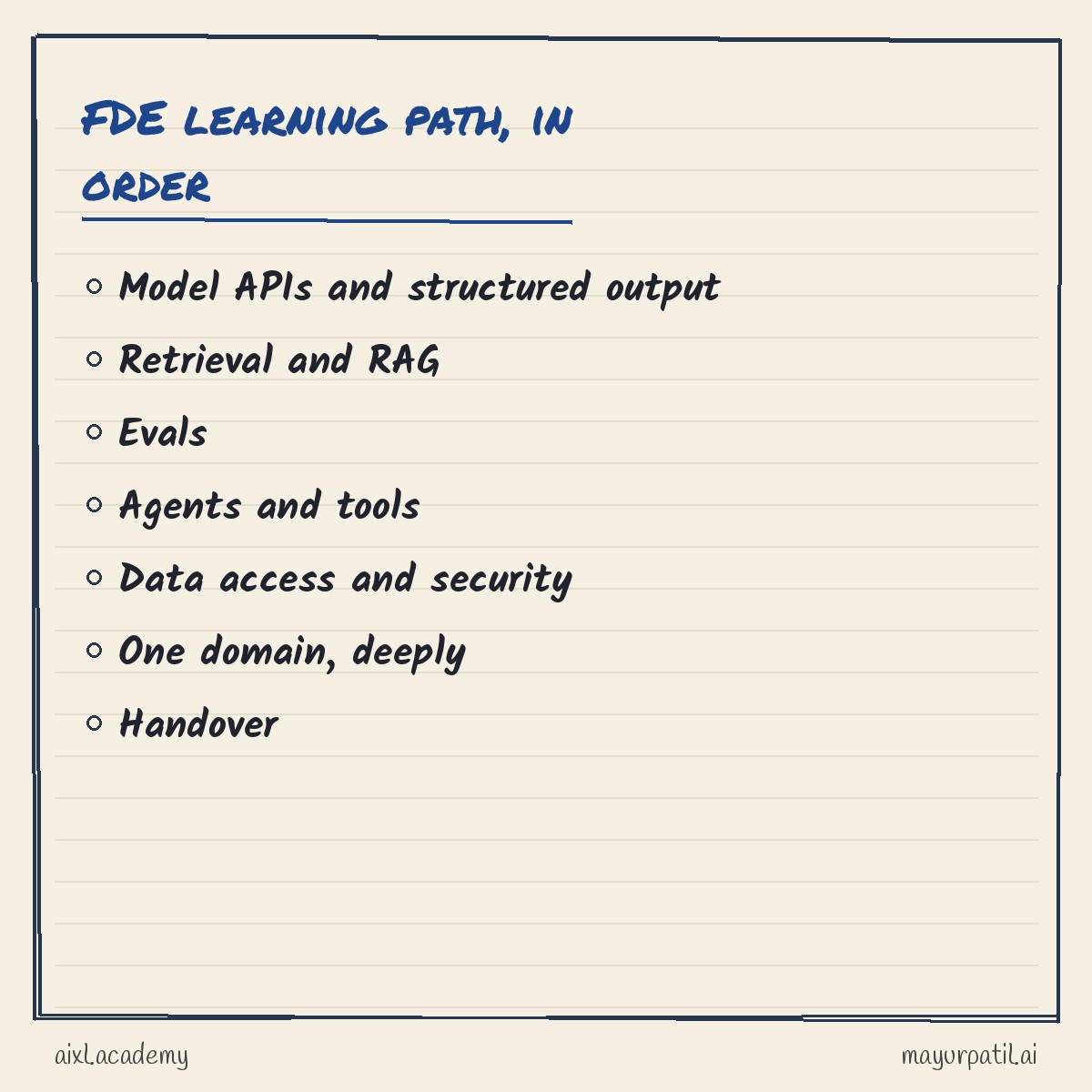
- Check the FDE learning path if the forward deployed route fits your answers.
The FDE cohort follows that route on a real build, with assessed work. It is one option among several, not the only route into AI.
Forward Deployed AI Engineering is a 60-hour live cohort for working engineers. The fee is USD 1,799 per participant. Enquire about the next intake.
Related reading: AI engineer roadmap, How to become a forward deployed engineer, and How to become an AI engineer.
Frequently asked questions
Try it first: turn on practice mode to hide the answers, think through each question, then reveal.
Can I move into forward deployed engineering without a computer science degree?
What a good answer covers
Yes, if you can write working software in Python, call APIs and use Git. Projects you can show matter more than the degree.
Is forward deployed engineering a good first AI role?
What a good answer covers
Usually not as a first step from zero. Build the AI engineering base first, then move onto the forward deployed route.
Which path is the most direct for experienced software engineers?
What a good answer covers
For people who already ship production code, moving from software engineering into AI engineering is often the most direct route. The FDE route then adds customer contact and handover.
Sources
- None: AIXL Academy curriculum practice, no external facts or figures.
Written by
AIXL Academy
AIXL Academy trains engineers to build and ship AI systems for real customers. Subscribe by RSS or follow the AIXL Academy page on LinkedIn for new question banks.
Train for this role
The cohort teaches these skills by building and shipping a system, assessed on the work.
Next cohorts: weekend from 21 November 2026, weekday from 18 November 2026.
forward deployed AI engineering courseKeep reading
Learning guide
AI for managers: what to learn if your team is deploying AI
What managers need to learn about AI when their team is deploying it: the questions to ask, the evals to request, and how a builder course differs.
Career guide
Switch career to AI: a plan that can lead to FDE work
A practical plan to switch career to AI, with an honest prerequisite check and the build steps that can lead toward forward deployed engineering work.